
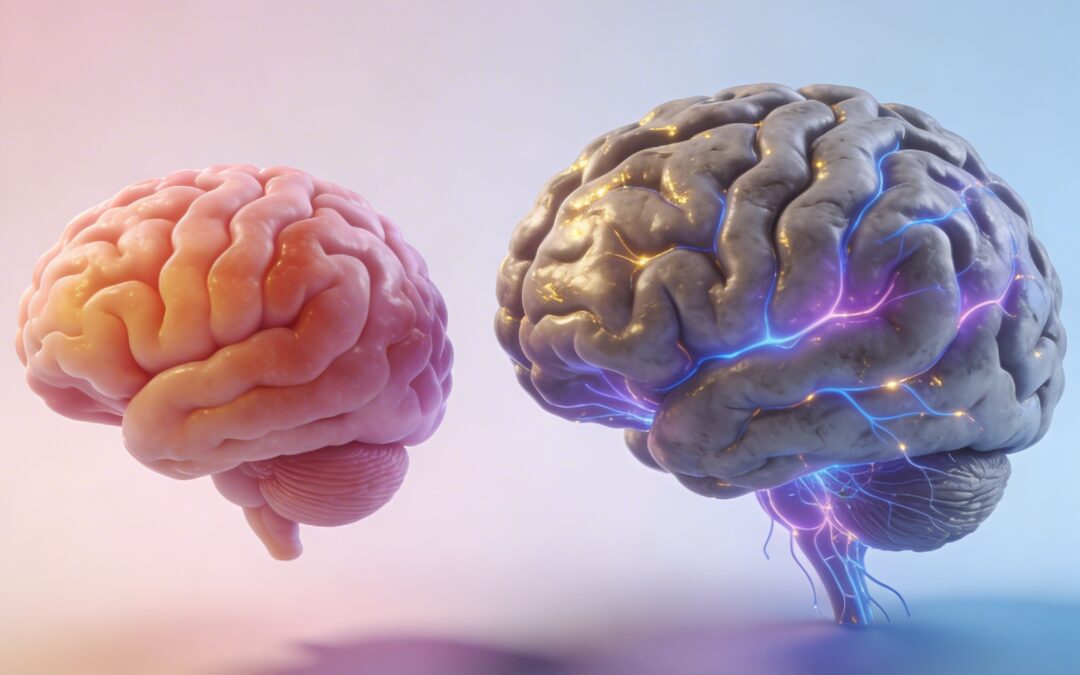
Think about the last time you learned something new. A recipe, a phone number, a shortcut on your commute. That simple act of learning rested on a foundation that began forming before you were born. The brain you use every day is the product of a continuous developmental process that starts in the womb and never truly stops.
Cognitive development isn’t something that happens only in childhood. It is the lifelong transformation of how we perceive, remember, reason, and solve problems. And thanks to modern neuroimaging, researchers can now watch this process unfold in real time, from the earliest weeks of gestation through late adulthood.
The Prenatal Blueprint
The human brain begins taking shape just three to four weeks after conception, when a flat sheet of cells folds into the neural tube. Failure of this tube to close properly results in conditions like spina bifida, underscoring how critical these early moments are. By five weeks, the three primary brain vesicles have formed, and the telencephalon, which will become the cerebral hemispheres, is already beginning to develop.
Between six and twenty-four weeks, neurons migrate to their assigned positions in the brain. This is not a random process. Neurons are generated near the ventricles and travel along radial glial guides to reach precise destinations. When this migration is disrupted, neurons can end up in the wrong locations, a condition associated with epilepsy and developmental delays.
The cerebral cortex, that wrinkled outer layer responsible for higher thought, begins forming its characteristic six layers around eight weeks. For most of gestation, the cortex remains smooth. But during the third trimester, it begins folding rapidly, creating the grooves and folds that allow our large brains to fit inside a compact skull. At birth, cortical thickness has reached about eighty percent of its maximum, but surface area is only at twenty-five percent. Most of that folding happens in those final months before delivery.
The brainstem and cerebellum develop earlier than the cortex, beginning around four to six weeks. These structures control basic physiological functions, respiration, heartbeat, balance, and also contribute to learning and emotional processing. They are interconnected with the cortex even before birth, forming circuits that will support everything from motor coordination to language.
What the Fetal Brain Actually Does
It would be inaccurate to attribute consciousness or self-awareness to a fetus. But it would also be inaccurate to describe the fetal brain as simply waiting around. Research over the past decade has revealed that the prenatal brain is actively processing information and building the neural infrastructure for later learning.
By the third trimester, fetuses show organized sleep-wake cycles. During active states, they move their limbs, make breathing movements, and even hiccup. During quiet states, they are nearly still. These patterns reflect maturation of brainstem and thalamocortical circuits.
Fetuses also respond to external stimulation. Vibroacoustic stimulation reliably triggers heart rate acceleration and body movements. More importantly, they show habituation, a decrease in responding to repeated stimulation. Habituation requires the brain to detect that a stimulus is no longer novel, to form a simple memory of having encountered it before. This is disrupted in fetuses with neurological abnormalities, suggesting it reflects genuine information processing capacity.
Perhaps most striking is evidence for statistical learning before birth. The fetus is exposed in utero to the rhythmic and prosodic features of speech, particularly the mother’s voice. Newborns prefer their mother’s voice over others and show differential neural responses to familiar speech rhythms. They have been detecting patterns in auditory input for months.
Brain imaging studies reveal that short-range neuronal connections develop particularly actively between twenty-six and twenty-nine weeks, while long-range connections grow more steadily throughout pregnancy. Sensory areas develop first, followed approximately four weeks later by areas supporting more complex cognitive functions. This hierarchical pattern suggests the brain is functionally organized well before birth.
Longitudinal research tracking fetuses with congenital heart disease compared to typical controls has shown that differences in cortical development emerge only after thirty weeks. Lower regional cortical surface area growth correlated with poorer neurodevelopmental outcomes at age two. The third trimester appears to be a critical period when reduced brain expansion becomes consequential for later cognition.
Critical Periods and Lifelong Plasticity
The concept of critical periods, windows of heightened sensitivity to environmental input, is well established in developmental neuroscience. The prenatal period is one such window. But it is not the only one.
Childhood brings explosive synaptogenesis, the overproduction of connections between neurons, followed by pruning of those that are not used. This process refines neural circuits based on experience, which is why enriched environments and language exposure matter so much in early years.
Adolescence involves another wave of remodeling, particularly in the prefrontal cortex. This region, essential for planning, impulse control, and decision making, is among the last to fully mature, continuing into the third decade of life. Anyone who has known a teenager will recognize that this developmental timeline has real behavioral consequences.
In adulthood, the brain remains plastic. Myelination, the insulation of neural pathways that enables rapid signal transmission, continues into middle age. Learning new skills generates new connections. Even in older age, while processing speed may decline and some aspects of memory may become less reliable, the brain retains the capacity for change. Wisdom, expertise, and accumulated knowledge represent genuine cognitive gains that can offset losses in other domains.
What This Means for Intervention
For those of us who study working memory and cognitive interventions, this developmental perspective is more than academic. It carries practical implications.
First, it suggests that the timing of interventions matters. Supporting brain development prenatally, through maternal health and nutrition, may have lifelong effects. Early childhood interventions targeting language and executive function can leverage periods of heightened plasticity. But it also means that later interventions are not futile. The adult brain, even the aging brain, retains plasticity.
Second, individual differences in cognitive capacity have developmental origins. The cortical folding patterns that emerge in the third trimester, the efficiency of neuronal migration, the quality of prenatal nutrition, all of these shape the brain each person brings into the world. Understanding these origins can help target interventions to those who need them most.
Third, the boundary between typical and atypical development is not as sharp as it once seemed. Many psychiatric and neurodevelopmental disorders involve disruptions of processes that begin prenatally. Abnormal cortical folding is a predictor of poor outcome across multiple conditions, and evidence now suggests these relationships begin when folding patterns first become established in utero.
The Continuity of Mind
The human brain is not assembled all at once. It builds itself progressively, each stage laying the groundwork for the next. The neural circuits that will someday support abstract reasoning, memory retrieval, and conscious thought begin taking shape in the darkness of the womb, long before they are needed.
This continuity has a humbling implication. The cognitive abilities you rely on today, your capacity to follow this argument, to remember what you read earlier, to relate it to your own experience, all depend on developmental processes that began before your birth. Your brain’s history is written into its structure.
But it also has an empowering implication. Because development is continuous, it is never truly finished. The plasticity that allows a fetal brain to adapt to its prenatal environment remains, in diminished form, throughout life. Interventions designed to strengthen cognitive capacity, whether in children with neurodevelopmental disorders, adults seeking to learn new skills, or older adults hoping to maintain function, are working with, not against, the brain’s fundamental nature.
The brain you have today is the product of everything that came before. And it is still, always, becoming something new.
References
Baillargeon, R. (1987). Object permanence in 3½-and 4½-month-old infants. Developmental Psychology, 23(5), 655-664.
Baltes, P. B., & Baltes, M. M. (1990). Psychological perspectives on successful aging: The model of selective optimization with compensation. In P. B. Baltes & M. M. Baltes (Eds.), Successful aging: Perspectives from the behavioral sciences (pp. 1-34). Cambridge University Press.
Baltes, P. B., & Staudinger, U. M. (2000). Wisdom: A metaheuristic (pragmatic) to orchestrate mind and virtue toward excellence. American Psychologist, 55(1), 122-136.
Bartrip, J., Morton, J., & de Schonen, S. (2001). Responses to mother’s face in 3-week to 5-month-old infants. British Journal of Developmental Psychology, 19(2), 219-232.
Held, R. (1993). Two stages in the development of binocular vision and eye alignment. In K. Simons (Ed.), Early visual development: Normal and abnormal (pp. 250-269). Oxford University Press.
Kisilevsky, B. S., Hains, S. M., Lee, K., Xie, X., Huang, H., Ye, H. H., Zhang, K., & Wang, Z. (2004). Effects of experience on fetal voice recognition. Psychological Science, 15(3), 220-224.
Kujala, T., Partanen, E., & Huotilainen, M. (2023). Prenatal experience and statistical learning. Developmental Science, 26(3), e13345.
Li, J., Zhang, H., Wang, Y., & Chen, X. (2025). The early alteration of brainstem and cerebellum, and their relationship with cerebral cortex: An in vivo fetal magnetic resonance imaging assessment. Quantitative Imaging in Medicine and Surgery. Advance online publication.
Lindseth, L. R. S., Beck, D., Westlye, L. T., Tamnes, C. K., & Norbom, L. B. (2025). Linking pregnancy- and birth-related risk factors to a multivariate fusion of child cortical structure. Proceedings of the National Academy of Sciences, 122(25), e2422281122.
Liu, Q., de Haan, M., Chant, K., Day, K. L., Lavander-Ferreira, M. J., Marlow, N., & Suarez-Rivera, C. (2025). A longitudinal study of preterm infants at 12 and 30 months: Links among object interactions, joint engagement, and cognitive development. Infancy, 30(2), e70016.
Mitchell, M. E., Jaimes, A. J., & Nugiel, T. (2025). Cognition is associated with task-related brain network reconfiguration in late childhood. bioRxiv, 2025.03.26.645532.
Munakata, Y., McClelland, J. L., Johnson, M. H., & Siegler, R. S. (1997). Rethinking infant knowledge: Toward an adaptive process account of successes and failures in object permanence tasks. Psychological Review, 104(4), 686-713.
Nelson, C. A. (2000). The neurobiological basis of early intervention. In J. P. Shonkoff & S. J. Meisels (Eds.), Handbook of early childhood intervention (2nd ed., pp. 204-227). Cambridge University Press.
O’Rahilly, R., & Müller, F. (2006). The embryonic human brain: An atlas of developmental stages(3rd ed.). Wiley-Liss.
Pagnozzi, A. M., van Eijk, L., Pannek, K., Boyd, R. N., Saha, S., George, J., Bora, S., Bradford, D., Fahey, M., Ditchfield, M., Malhotra, A., Liley, H., Colditz, P. B., Rose, S., & Fripp, J. (2023). Early brain morphometrics from neonatal MRI predict motor and cognitive outcomes at 2-years corrected age in very preterm infants. NeuroImage, 267, 119815.
Piaget, J. (1952). The child’s conception of number. Routledge & Kegan Paul.
Piaget, J. (1954). The construction of reality in the child. Basic Books.
Pramono, M. B. A., Sutrisna, B., & Wibowo, N. (2025). Fetal neurobehavior and consciousness: A systematic review of 4D ultrasound evidence and ethical challenges. Journal of Perinatal Medicine. Advance online publication.
Riley, E., Thompson, G., & Martinez, L. (2025). Blood oxygenation level-dependent responses in neuromodulatory nuclei and their associations with attention and memory across age groups. Neurobiology of Aging, 155, 24-34.
Saffran, J. R., Aslin, R. N., & Newport, E. L. (1996). Statistical learning by 8-month-old infants. Science, 274(5294), 1926-1928.
Salthouse, T. A. (1996). The processing-speed theory of adult age differences in cognition. Psychological Review, 103(3), 403-428.
Salthouse, T. A. (2010). Major issues in cognitive aging. Oxford University Press.
Scarr, S., & McCartney, K. (1983). How people make their own environments: A theory of genotype → environment effects. Child Development, 54(2), 424-435.
Stern, Y. (2009). Cognitive reserve. Neuropsychologia, 47(10), 2015-2028.
Stratton, P., & Hayes, N. (1999). A student’s dictionary of psychology. Arnold.
Whitehead, K., Pillay, N., & Adams, E. (2024). Co-developing sleep-wake and sensory foundations for cognition in the human fetus and newborn. Developmental Cognitive Neuroscience, 71, 101487.
Wilson, S. M., Roberts, A. C., & Thompson, D. K. (2025). Foetal cortical expansion is associated with neurodevelopmental outcome at 2-years in congenital heart disease: A longitudinal follow-up study. eBioMedicine, 114, 105679.
Zhang, L., Ross, B., Du, Y., & Alain, C. (2025). Long-term musical training can protect against age-related upregulation of neural activity in speech-in-noise perception. PLoS Biology, 23(7), e3003247.