
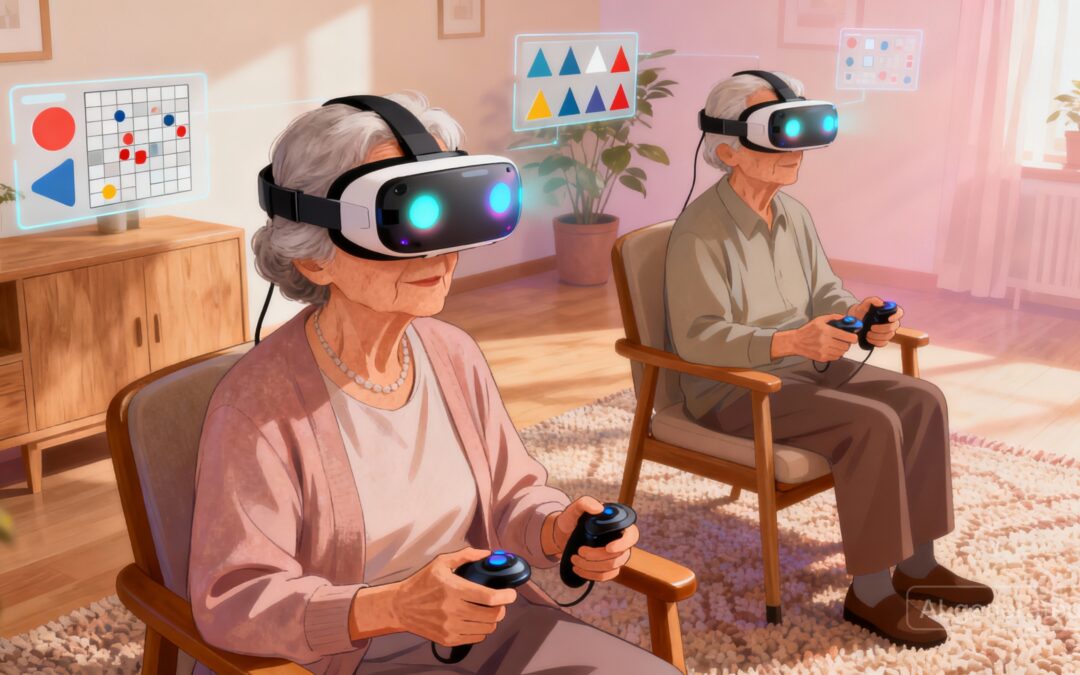
Mild Cognitive Impairment (MCI) represents a critical prodromal stage for dementia, necessitating effective interventions to slow cognitive decline. While pharmacological treatments have shown limited efficacy, non-pharmacological approaches, particularly cognitive training, have gained prominence. This article synthesizes current evidence on the efficacy of cognitive training for MCI, with a specific focus on the emerging paradigm of Virtual Reality (VR)-based interventions. Recent meta-analytic evidence indicates that VR-based cognitive training produces a statistically significant, medium-sized effect on global cognitive function in individuals with MCI (Hedges’s *g*= 0.60). A critical finding is that the efficacy of these interventions is moderated by their design; VR-based games may offer superior benefits compared to structured VR cognitive training, potentially due to enhanced engagement and intrinsic motivation. Furthermore, the level of technological immersion has been identified as a significant positive moderator of cognitive outcomes. This suggests that fully immersive systems that foster a strong sense of presence may lead to greater neural activation and functional improvement. Despite promising results, the evidence base is characterized by heterogeneity and a predominance of short-term trials. Future research should prioritize large-scale, longitudinal randomized controlled trials with standardized immersion metrics and personalized protocols to solidify clinical translation and optimize cognitive preservation in MCI.
Introduction
Mild Cognitive Impairment (MCI) is a clinical syndrome characterized by a cognitive decline that is greater than expected for an individual’s age and education level, yet not severe enough to interfere significantly with independent daily functioning (Petersen et al., 2018). It represents a high-risk state for progression to dementia, with annual conversion rates estimated at 5-15%, compared to 1-2% in the general elderly population (Petersen et al., 2018; Anderson, 2019). Given the limited efficacy of pharmacological treatments in halting this progression, the development of effective non-pharmacological interventions has become a paramount objective in geriatric neurology and neurorehabilitation.
Cognitive training, defined as the guided practice of standardized tasks designed to reflect specific cognitive domains such as memory, executive function, and attention, is one of the most extensively studied non-pharmacological approaches (Petersen et al., 2018). The theoretical foundation of cognitive training lies in the principle of experience-dependent neuroplasticity, positing that targeted mental stimulation can strengthen neural circuits and enhance cognitive reserve (Anderson, 2019). However, traditional cognitive training, often delivered via paper-and-pencil or computerized tasks, has faced criticism for its limited transfer of benefits to everyday activities, a challenge known as the “far transfer” problem.
The advent of Virtual Reality (VR) technology offers a compelling solution to this limitation. VR enables the creation of ecologically valid, multi-sensory environments where cognitive challenges can be embedded within simulated activities of daily living (Zhong et al., 2021). This immersive quality is hypothesized to enhance engagement and promote greater transfer of training effects to real-world functioning. VR interventions for cognitive rehabilitation generally manifest in two distinct forms: VR-based cognitive training, which involves structured, repetitive exercises in a virtual environment, and VR-based games, which integrate cognitive tasks within an engaging, narrative-driven gameplay framework (Yuan et al., 2025).
Recent systematic reviews and meta-analyses have begun to consolidate the evidence for VR in MCI. The purpose of this article is to synthesize these findings, with a particular focus on the efficacy of VR-based cognitive training and games, and to discuss critical moderating factors such as immersion level that are shaping the future of this innovative therapeutic modality.
Efficacy of VR-Based Cognitive Training
A growing body of evidence from randomized controlled trials (RCTs) supports the efficacy of VR-based cognitive training for improving cognitive function in MCI. A seminal meta-analysis by Yuan et al. (2025) synthesized data from 11 RCTs and found a significant, medium-sized positive effect of VR interventions on global cognitive performance compared to control conditions (Hedges’s *g*= 0.60, 95% CI: 0.29 to 0.90, *p* < 0.05). Control groups in these studies ranged from passive controls (e.g., wait-list, health education) to active controls (e.g., traditional cognitive training, physical exercise).
The interventions categorized as VR-based cognitive training often involve simulated functional activities. For instance, Buele et al. (2024) utilized a VR kitchen search task, while Liao et al. (2020) implemented a VR-based program centered on activities of daily living. These studies demonstrated improvements on standardized cognitive measures such as the Montreal Cognitive Assessment (MoCA), suggesting that training within ecologically valid environments can translate to gains on general cognitive screens. The underlying mechanism is thought to involve the enhanced engagement of neural networks supporting memory and executive function through multi-sensory stimulation and real-time interaction within a three-dimensional space (Zhong et al., 2021).
VR-Based Games versus Structured Training: The Role of Engagement
An intriguing finding from the Yuan et al. (2025) meta-analysis is the differential effect observed between types of VR interventions. Subgroup analysis revealed that while both VR-based cognitive training (Hedges’s *g* = 0.52) and VR-based games (Hedges’s *g* = 0.68) were effective, games demonstrated a trend toward a larger effect size. VR games, such as those used in studies by Thapa et al. (2020) and Yang et al. (2022), prioritize immersive narratives and compelling gameplay, embedding cognitive challenges within goals like solving puzzles or completing virtual missions.
The superior trend in efficacy associated with game-based approaches is often attributed to higher levels of user engagement, intrinsic motivation, and enjoyment (Tao et al., 2021). This heightened engagement may lead to greater adherence and more sustained cognitive effort during training sessions. The game-like elements, such as reward systems and adaptive difficulty, can create a more positive and less tedious rehabilitation experience, thereby potentially enhancing the overall therapeutic outcome by leveraging principles of motivated learning and emotional salience (Amjad et al., 2019).
Immersion Level as a Critical Moderator
Beyond the content of the intervention, the technical parameters of the VR system itself have been identified as a significant factor influencing efficacy. Yuan et al. (2025) conducted a meta-regression analysis classifying studies based on the level of immersion—categorized as low (e.g., screen-based with controllers), moderate (e.g., head-mounted displays with 3 degrees-of-freedom), or high (e.g., head-mounted displays with 6 degrees-of-freedom and natural interaction). Their analysis identified immersion level as a statistically significant and positive moderator of cognitive improvement (β = 0.834, *p* < 0.05).
This finding indicates that each incremental increase in immersion is associated with a greater effect size. High-immersion systems, which fully occlude the user’s visual field to the physical world and allow for naturalistic interaction, foster a stronger psychological sense of “presence” (Cummings & Bailenson, 2016). This profound sense of being within the virtual environment is believed to heighten cognitive load and elicit more robust neural activation in brain regions critical for memory and learning, such as the hippocampus and prefrontal cortex, thereby potentiating the therapeutic benefits of the training (Kang et al., 2021).
Conclusion and Future Directions
The cumulative evidence firmly establishes that cognitive training, particularly when delivered through immersive VR platforms, is an effective non-pharmacological intervention for enhancing cognitive function in individuals with MCI. The efficacy is moderated by both the design philosophy—with game-based approaches showing promise for superior engagement—and the technical level of immersion, where more sophisticated systems yield stronger outcomes.
Despite these encouraging findings, several challenges remain. The evidence base, as graded by Yuan et al. (2025), is of moderate certainty overall, with the certainty for VR games specifically being low, highlighting the need for more rigorous and large-scale RCTs. Future research must address the heterogeneity in intervention protocols and develop standardized metrics for defining and measuring immersion. Furthermore, investigations into long-term adherence, the sustainability of cognitive benefits, and the development of personalized VR interventions tailored to individual cognitive profiles and etiological subtypes of MCI are essential next steps. As VR technology becomes more accessible, its integration into clinical and home-based care models holds significant potential for altering the trajectory of cognitive decline in this at-risk population.
References
Amjad, I., Toor, H., Niazi, I. K., Pervaiz, S., Jochumsen, M., Shafique, M., & Niazi, A. K. (2019). Xbox 360 Kinect cognitive games improve slowness, complexity of EEG, and cognitive functions in subjects with mild cognitive impairment: A randomized control trial. Games for Health Journal, 8(2), 144–152. https://doi.org/10.1089/g4h.2018.0029
Anderson, N. D. (2019). State of the science on mild cognitive impairment (MCI). CNS Spectrums, 24(1), 78–87. https://doi.org/10.1017/S1092852918001347
Buele, J., Avilés-Castillo, F., Del-Valle-Soto, C., Varela-Aldás, J., & Palacios-Navarro, G. (2024). Effects of a dual intervention (motor and virtual reality-based cognitive) on cognition in patients with mild cognitive impairment: A single-blind, randomized controlled trial. Journal of Neuroengineering and Rehabilitation, 21(1), 130. https://doi.org/10.1186/s12984-024-01422-w
Cummings, J. J., & Bailenson, J. N. (2016). How immersive is enough? A meta-analysis of the effect of immersive technology on user presence. Media Psychology, 19(2), 272–309. https://doi.org/10.1080/15213269.2015.1015740
Kang, J. M., Kim, N., Lee, S. Y., Woo, S. K., Park, G., Yeon, B. K., & Lee, J. Y. (2021). Effect of cognitive training in fully immersive virtual reality on visuospatial function and frontal-occipital functional connectivity in predementia: Randomized controlled trial. Journal of Medical Internet Research, 23(8), e24526. https://doi.org/10.2196/24526
Liao, Y. Y., Tseng, H. Y., Lin, Y. J., Wang, C. J., & Hsu, W. C. (2020). Using virtual reality-based training to improve cognitive function, instrumental activities of daily living and neural efficiency in older adults with mild cognitive impairment. European Journal of Physical and Rehabilitation Medicine, 56(1), 47–57. https://doi.org/10.23736/S1973-9087.19.05899-4
Petersen, R. C., Lopez, O., Armstrong, M. J., Getchius, T. S. D., Ganguli, M., Gloss, D., Gronseth, G. S., Marson, D., Pringsheim, T., Day, G. S., Sager, M., Stevens, J., & Rae-Grant, A. (2018). Practice guideline update summary: Mild cognitive impairment. Neurology, 90(3), 126–135. https://doi.org/10.1212/WNL.0000000000004826
Tao, G., Garrett, B., Taverner, T., Cordingley, E., & Sun, C. (2021). Immersive virtual reality health games: A narrative review of game design. Journal of Neuroengineering and Rehabilitation, 18(1), 31. https://doi.org/10.1186/s12984-020-00801-3
Thapa, N., Park, H. J., Yang, J. G., Son, H., Jang, M., Lee, J., Park, J. H., & Park, K. W. (2020). The effect of a virtual reality-based intervention program on cognition in older adults with mild cognitive impairment: A randomized control trial. Journal of Clinical Medicine, 9(5), 1283. https://doi.org/10.3390/jcm9051283
Yang, J. G., Thapa, N., Park, H. J., Bae, S., Park, K. W., Park, J. H., & Park, H. (2022). Virtual reality and exercise training enhance brain, cognitive, and physical health in older adults with mild cognitive impairment. International Journal of Environmental Research and Public Health, 19(20), 13300. https://doi.org/10.3390/ijerph192013300
Yuan, P., Chen, J., Peng, D., Yang, Q., Liu, B., & Lu, C. (2025). Effectiveness of VR-based cognitive training and games on cognitive rehabilitation in patients with MCI: A systematic review and meta-analysis. Frontiers in Neurology, 16, 1691344. https://doi.org/10.3389/fneur.2025.1691344
Zhong, D., Chen, L., Feng, Y., Song, R., Huang, L., Liu, J., & Zhang, L. (2021). Effects of virtual reality cognitive training in individuals with mild cognitive impairment: A systematic review and meta-analysis. International Journal of Geriatric Psychiatry, 36(12), 1829–1847. https://doi.org/10.1002/gps.5603