
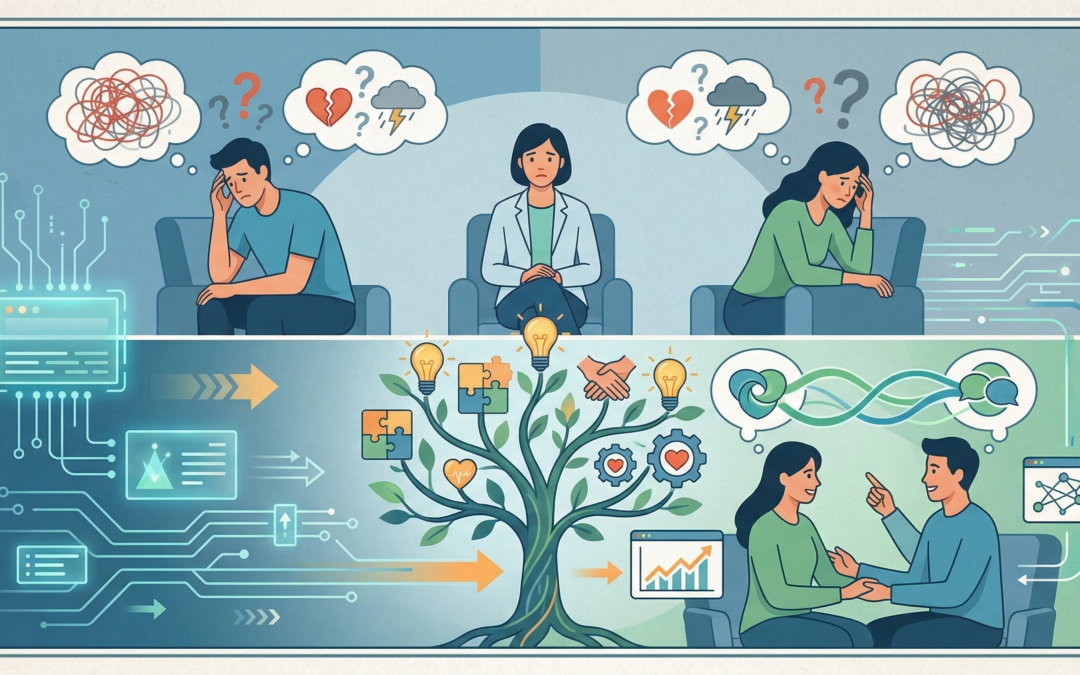
The integration of cognitive training approaches into couples therapy represents a growing frontier in relationship science. While traditional cognitive-behavioural couple therapy (CBCT) has long emphasised the role of maladaptive cognitions in relationship distress, recent technological advances have enabled the development of computerised and structured cognitive training programmes that can be delivered remotely. This article synthesises current research on how cognitive training, particularly when delivered through digital platforms, may enhance couples therapy outcomes.
Cognitive-Behavioural Couple Therapy: The Foundational Framework
Before examining computerised approaches, it is essential to understand the theoretical foundation upon which they build. Cognitive-behavioural couple therapy (CBCT) operates on the principle that relationship distress arises from the interaction between partners’ cognitions, behaviours, and emotional responses. A recent comprehensive literature review examining 25 articles published between 1996 and 2024 identified five primary domains where CBCT demonstrates measurable effects: mental health, sexuality, conflict resolution, stress reduction, and overall marital quality (Othman, Mohd Rifin, & Hassan, 2025). This review noted that 15 studies involved 517 couples, while 10 studies included 484 individual participants, with the majority employing true experimental or quasi-experimental designs (Othman et al., 2025).
The clinical application of CBCT has expanded beyond general relationship distress to address specific presenting problems. A 2025 feasibility study tested a 16-session CBCT intervention delivered online by doctoral-level therapists to 19 couples in which the female partner was diagnosed with Sexual Interest/Arousal Disorder (SIAD) (Bouchard, Bergeron, & Rosen, 2025). The intervention, grounded in the Interpersonal Emotion Regulation Model of women’s sexual dysfunction, targeted unhelpful cognitions and behaviours while addressing difficulties with emotional experiences within the couple (Bouchard et al., 2025). Results demonstrated high therapist adherence to the treatment manual, high rates of homework completion, low dropout rates, and moderately high global treatment satisfaction. Women with SIAD reported large improvements in dyadic sexual desire and sexual distress from pre-treatment to post-treatment and at six-month follow-up, while partners reported moderate improvements in sexual distress (Bouchard et al., 2025).
Computerised and Online Cognitive Interventions for Couples
The digital transformation of mental health services has produced several innovative computerised interventions that target cognitive processes relevant to couple functioning. These programmes range from brief writing-based reappraisal tasks to comprehensive multi-week structured interventions.
Brief Conflict Reappraisal Interventions
One promising approach involves brief, structured cognitive training delivered through online platforms. The Love Together, Parent Together (L2P2) programme is a brief online couples intervention designed to prevent relationship deterioration by targeting maladaptive psychological processes (Voldstad et al., 2025). A pilot randomised controlled trial examined this intervention with 140 couples with young children (under six years old) who were randomly assigned to the L2P2 programme or a control group. Over nine weeks, all couples completed three writing sessions summarising recent conflicts; however, the L2P2 group additionally responded to three writing prompts eliciting conflict reappraisal (Voldstad et al., 2025).
The results revealed that while the control group showed deteriorating relationship quality from baseline to post-intervention, the L2P2 group did not experience this decline, suggesting that brief cognitive reappraisal training may attenuate normative declines in relationship satisfaction among couples navigating the stressors of early parenthood (Voldstad et al., 2025). This finding is particularly significant given that the intervention required minimal time investment and could be completed entirely online.
Coach-Guided Online Interventions for Specific Populations
More intensive online interventions have been developed for couples facing specific mental health challenges. Couple HOPES (Helping Overcome PTSD and Enhance Satisfaction) is a coach-guided online intervention designed for couples wherein one member experiences posttraumatic stress disorder (PTSD) symptoms (Fitzpatrick et al., 2025). A randomised waitlist-controlled trial recruited 67 couples where one partner met criteria for likely PTSD and was either a military member, veteran, first responder, health care worker, or whose PTSD symptoms were related to COVID-19. Couples were randomised to receive the intervention immediately or after an eight-week waiting period, with outcomes measured at multiple time points including one- and three-month follow-ups (Fitzpatrick et al., 2025).
Intent-to-treat analyses demonstrated greater improvements in both self-reported and informant-reported PTSD among those receiving Couple HOPES relative to the waitlist, with large and medium effect sizes respectively. Partners without PTSD symptoms reported greater improvements in relationship satisfaction with a small effect size, although individuals with PTSD symptoms did not show significant improvements in this domain (Fitzpatrick et al., 2025). The researchers concluded that this low-cost, scalable intervention shows efficacy for improving PTSD regardless of whether symptoms were COVID-19-related, though they noted the need for further testing with larger sample sizes (Fitzpatrick et al., 2025).
Online Dyadic and Mindfulness Interventions
Research has increasingly explored whether online contemplative practices, particularly those involving partner-based exercises, can improve psychological outcomes relevant to couple functioning. A randomised controlled trial with 285 participants compared the efficacy of 10-week online mindfulness-based and partner-based socio-emotional dyadic interventions, both supported by weekly coaching sessions (Godara, Hecht, & Singer, 2024). The interventions were app-delivered and designed to be more scalable than intensive in-person programmes, addressing the need for accessible mental health support highlighted during the COVID-19 pandemic (Godara et al., 2024).
Both interventions led to reductions in depression and emotion regulation difficulties compared to the waitlist control group. However, domain-specific effects emerged: trait anxiety decreased only after mindfulness training, while increases in multidimensional resilience were observed only after socio-emotional training (Godara et al., 2024). Notably, the socio-emotional training led to significant reductions in negative interpretation bias, as measured by the mouse-contingent Scrambled Sentences Task, and this reduction mediated improvements in depression and trait anxiety (Godara et al., 2024). Neither training led to reductions in negative attention bias, suggesting that different cognitive mechanisms may be differentially responsive to specific intervention types (Godara et al., 2024).
These findings are particularly relevant for couples therapy because negative interpretation bias—the tendency to interpret ambiguous situations negatively—has been implicated in relationship distress. Partners who interpret a partner’s ambiguous behaviour (e.g., coming home late) through a negative lens (e.g., “they don’t care about me”) rather than a neutral or positive lens (e.g., “they must have been stuck in traffic”) are more likely to experience conflict and relationship dissatisfaction. The demonstration that online partner-based training can reduce this bias suggests a mechanism through which such interventions might improve couple outcomes.
Mindfulness Interventions for Couples: Meta-Analytic Evidence
Mindfulness-based interventions represent another form of cognitive training with relevance to couple functioning. A comprehensive systematic review and meta-analysis examined the effect of mindfulness interventions on couple relationship satisfaction (Karremans, 2026). The researchers analysed 90 effect sizes nested within 28 studies including 6,097 participants in couple relationships. Randomised controlled trials of mindfulness interventions that included measures of relationship satisfaction were selected based on systematic searches across seven major databases (Karremans, 2026).
Initial analysis revealed a significant medium effect on relationship satisfaction (g = 0.60), though with high heterogeneity. However, this effect was influenced by extreme outliers, and removing outliers resulted in a significant small effect with low heterogeneity (g = 0.21) (Karremans, 2026). Effects were moderated by intervention length, baseline satisfaction, and risk of bias, with significant effects observed for both clinical and community samples. Importantly, the researchers rated the certainty of evidence as very low due to inconsistency, imprecision, risk of bias, and suspicion of publication bias, noting that generalisation is limited by insufficient reporting (Karremans, 2026).
The authors concluded that while mindfulness interventions can help people feel more satisfied with their couple relationships, the quality of evidence points to the need for stronger programme theory and more rigorous methodology in future studies (Karremans, 2026). This cautious conclusion highlights the importance of interpreting positive findings with appropriate scepticism and emphasises the need for continued research refinement.
Mechanisms of Cognitive Training Effects
Understanding how cognitive training produces its effects is essential for optimising intervention design. The research reviewed here suggests several potential mechanisms.
First, reduction in negative interpretation bias appears to be a specific mechanism for socio-emotional dyadic training (Godara et al., 2024). This finding aligns with cognitive models of psychopathology that emphasise the role of biased information processing in the onset and maintenance of emotional disorders. By training couples to interpret ambiguous situations more positively or neutrally, interventions may reduce conflict and improve relationship satisfaction.
Second, improved emotion regulation emerged as a shared outcome across both mindfulness and socio-emotional interventions (Godara et al., 2024). Emotion regulation difficulties have been implicated in relationship distress, as partners who cannot effectively manage their emotional responses are more likely to engage in destructive conflict patterns. Both online interventions led to reductions in emotion regulation difficulties, suggesting that cognitive training may enhance couples’ capacity to manage emotional reactions during conflicts.
Third, increased resilience specifically following socio-emotional training (Godara et al., 2024) suggests that partner-based cognitive interventions may strengthen couples’ ability to withstand and recover from stressors. This finding has particular relevance for couples facing chronic challenges such as illness, financial stress, or caregiving demands.
Limitations and Future Directions
Despite promising findings, several limitations warrant consideration. The subclinical nature and overrepresentation of females in many samples limits generalisability to clinical populations and to couples where male partners are the identified patients (Bouchard et al., 2025). Additionally, the very low certainty of evidence in the mindfulness meta-analysis (Karremans, 2026) underscores the need for more rigorous methodology, including larger sample sizes, active control conditions, and longer follow-up periods.
The feasibility study of CBCT for SIAD, while demonstrating promising results, included only 19 couples and lacked a control group (Bouchard et al., 2025). The authors appropriately call for a randomised clinical trial to establish efficacy. Similarly, the Couple HOPES trial, while methodologically rigorous, noted the need for larger sample sizes and observed reversion of gains in some outcomes at follow-up (Fitzpatrick et al., 2025), suggesting that booster sessions or maintenance strategies may be necessary.
The ongoing randomised controlled trial of Mindfulness-Based Couples Intervention (MBCI) in the Netherlands addresses several methodological limitations by including an active control intervention (self-expansion training) and a waitlist control group, with assessments extending to six months post-intervention (Karremans, 2026). This trial will compare an eight-week mindfulness-based couples intervention to both an active control and a waitlist, with 213 couples expected to participate across five centres (Karremans, 2026). The results of this trial will substantially advance understanding of whether mindfulness training produces effects specific to the intervention or attributable to non-specific factors such as group support and expectancy.
Implications for Practice
For clinicians working with couples, the current evidence supports several conclusions. First, online and computerised cognitive interventions can produce meaningful improvements in relationship outcomes, with the advantage of scalability and accessibility. Second, different types of training may produce different effects: mindfulness training may be particularly helpful for anxiety and stress recovery, while socio-emotional partner-based training may be more effective for building resilience and reducing negative interpretation bias (Godara et al., 2024). Third, brief interventions such as the L2P2 reappraisal writing task (Voldstad et al., 2025) may be sufficient to prevent relationship deterioration in at-risk populations, suggesting that not all couples require intensive, long-term treatment.
The integration of cognitive training into couples therapy need not replace traditional approaches but may augment them. Clinicians might incorporate computerised reappraisal tasks as homework between sessions, recommend app-based mindfulness training as an adjunct to therapy, or refer couples to coach-guided online programmes when in-person therapy is inaccessible. The evidence suggests that such approaches can produce measurable improvements in both individual mental health outcomes and relationship functioning.
Conclusion
Research on cognitive training to support couples therapy has advanced considerably, with evidence now supporting the efficacy of computerised and online interventions for improving relationship outcomes. Brief reappraisal tasks can prevent relationship deterioration (Voldstad et al., 2025), coach-guided online programmes can reduce PTSD symptoms and improve partner satisfaction (Fitzpatrick et al., 2025), and structured dyadic training can reduce negative interpretation bias and enhance resilience (Godara et al., 2024). Mindfulness interventions produce small but consistent improvements in relationship satisfaction (Karremans, 2026), though methodological limitations warrant cautious interpretation.
As digital mental health interventions continue to evolve, the integration of cognitive training principles into accessible, scalable formats holds promise for reaching couples who might otherwise not access services. The challenge for future research is to identify which components of these interventions are essential, for whom they are most effective, and how they can be optimally integrated with traditional couples therapy approaches.
References
Bouchard, K. N., Bergeron, S., & Rosen, N. O. (2025). Feasibility of a cognitive-behavioral couple therapy intervention for sexual interest/arousal disorder. Journal of Sex Research. Advance online publication.
Fitzpatrick, S., et al. (2025). A randomized controlled trial testing couple HOPES: An online, self-help couples’ intervention for posttraumatic stress disorder. Journal of Consulting and Clinical Psychology, *93*(8), 580–594.
Godara, M., Hecht, M., & Singer, T. (2024). Training-related improvements in mental well-being through reduction in negative interpretation bias: A randomized trial of online socio-emotional dyadic and mindfulness interventions. Journal of Affective Disorders, *354*, 662–672.
Karremans, J. (2026). Evaluating mindfulness-based couples intervention (MBCI): A randomised feasibility trial and progression to a full-scale trial. Behavioural Science Institute.
Othman, M. H., Mohd Rifin, M. H., & Hassan, H. (2025). The effect of cognitive behavioral couples therapy (CBCT) in marital: A literature review. In Seminar Kebangsaan Dalam Kepelbagaian Penyelidikan dan Pendidikan 2025. International Islamic University Malaysia.
Voldstad, A., et al. (2025). The effect of mindfulness interventions on couple relationship satisfaction: A systematic review and meta-analysis. Journal of Consulting and Clinical Psychology, *93*(6), 427–442.